Thursday, April 19, 2012

The Locals

What's a country without its people? The people of Jamaica are a colorful lot, and I've been lucky enough to snag a few candid photos of them along the way. Enjoy! I'll add more photos to this post as they come along.
I saw this fresh looking girl while driving through downtown Montego Bay. I couldn't help but snap a shot through the window.
Here's another nice girl with an even nicer weave.
 
This mean muggin' fellow was crossing the street in downtown Mo'Bay.
A sight like this was too good to pass up.
Shawn took this photo from out the car window on the outskirts of Kingston. What fashion sense!
This young lad began washing our windshield before we had any say about it. He targeted us because we were a.) first at the red light b.) a car full of whities. It sure did pay off for him!
A man goes fishing.

Sunday, April 15, 2012

Vacation in Negril

Situated on the westernmost tip of Jamaica, Negril serves up the American fantasy on a fat Jamaican plate. Here, things are nice, with sun-tanned bodies on white beaches, fruity drinks, and hotels on exclusive cliffs. Not to mention, the local flavor, live reggae music, and parties to party at until you drop. Having spent so much time up in the hills, we were all fiending for such a place, and when we were granted a few days off we headed to Negril. What did we do there? Well…

Laura and I chose to stay at the Negril Yoga Centre. You may be wondering whether we are underground yoga pros, and the answer to that is… No, but we saw a lot of yoga pros. The place was across from the beach and offered simple, comfortable accommodations and a communal kitchen, all tucked into a lush garden. And it was cheap. What else do you need?

After settling in the first evening, we headed out onto the beach to check out the scene and wound up at a placed called Bourbon Bar, which was also a large music venue. The open-air bar was right on the ocean, facing the west for a priceless sunset.

The music wasn’t going to start until later on, so we spent our time people watching. People of all sorts were walking along the beachfront – white, black, American, European and Jamaican. Three middle-aged American men drooped over the bar, battling to keep their eyes open. The most energetic of the trio kept spurring the other two into action, convincing them to stay up longer and to re-up for the impending nighttime parties.

Vendors traveled endlessly up and down the beach selling cigarettes, sunglasses, zip-locked fruit and drugs, hustling anyone that gave them the time of day. At every restaurant we ate, the waiters offered to sell us weed under the table, whispering deals of hash and the finest ganja. Along the beachfront, local artisans ushered people into their beachside huts where they would implore you to buy something from them. Each hut had basically the same things as the one next to it - mostly cookie cutter shaped wooden carvings, some of them quite cheesy. Rumor on the street was that some of the carvings were actually mass-produced in China and then sold to naive tourists!!!!! We also learned later that the cigarettes that were sold on the beach weren’t the brand that they claimed to be. They were rip offs! Not that that affected us at all.

After a little while of sitting at the bar we were approached by a young Jamaican man who was working for the venue, selling tickets for a Gyptian concert coming in a few weeks. We told him that we worked up in Betheltown and that we were only down for a few days and asked him if he had any particular recommendations for us. He told us that without a doubt we should rent a scooter, and that he would hook us up with a good deal. Laura and I were instantly intrigued, and so began an hour-long session of scooter haggling, involving our new friend Bryan and his scooter friend Aleem.

Next thing we knew, it was the following morning and our scooter was about to arrive at the Yoga Centre (In true Jamaican fashion it arrived two hours late). Laura signed the papers and just like that we had a scooter at our disposal for the next 24 hours. After preparing a daypack full of snorkel gear and snax, we hopped on and peeled out onto the left side of the road. What was our destination? What else but the famous cliffs of Negril’s south end.

Rounding the first bend, some locals screamed out at us not to wreck, while others tried to convince us of their tour guide capabilities. We ignored them the best we could and Laura revved it, dodging potholes and the light oncoming traffic. The cliff top was lined with resort after resort, all offering the same thing: bar, patio, and water access for swimming and snorkeling. Some establishments had networks of caves that you could walk through to get down to the water, while others advertised cliffs that you could jump off. One such place was Rick’s CafĂ©, which was self-proclaimed world famous. We stopped to check it out and found it to be rather ridiculous. It was comprised of an immense, flavorless concrete expanse, replete with verandas and gift shops. The cliffs were overrun with locals that jumped off a 95-foot crow’s nest to get tips. They hassled us endlessly to tip them for their performances; Laura got talked into swimming into some caves with some locals and enjoyed herself until they demanded a $6 tip afterward. We did, however, take a few jumps off the 40-foot cliffs which was exhilarating. Soon after that however, we left in search of a more down to earth locale.

We found our favorite spot at a place called Xtabi, where we sat at a table on the cliff and drank a pina colada as white-tailed tropicbirds chased each other through the sky. After relaxing, we hopped in the deep water and snorkeled around, though the coral was bleached and devoid of anything too spectacular. Regardless, the sheer warmth and clarity of the water made the moment quite surreal.

By this point, Laura had become quite the pro at the scooter. I had had a go of it earlier in the day (which ended up costing us $65 for a new paint job), but soon decided my inexperienced hand might become a liability. Laura was the only driver now. Heading past the lighthouse south out of town we found long uninhabited straightaways cutting through the ruinate woodlands, where Laura revved it and we topped out at 57 KPH.

That evening we headed back to the beachfront for a late dinner at a hut selling jerk chicken. The cook was a kind man who worked there with his wife, and since we were his only customers he lit up a spliff and sat down with us. He told us all about the crazy spring breakers and how rude and loud they were, doing every drug under the moon, from coke and heroin to acid and pills. He emphasized with us over and over that he strictly smoked the ganja and seemed disgusted by the tourists for their heathen ways. I didn’t argue with him, though he did think their rampant sex and skinny-dipping was shameful. :-/ Too tired from our busy day, we missed out on the live music again and fell asleep on the early side of things.

Our final morning, we decided to enjoy the beach life one more time, crossing the road and claiming two shaded beach chairs. We purloined a crossword, read our books, and took a quick dip in the calm water. Then we battled it out in a final ping pong match, playing the onshore breeze as we spun winners back and forth.

Saturday, March 31, 2012

Puppies

One afternoon not too long ago, eleven puppies wandered out of the crawlspace into the front yard. They nipped, stumbled, and whined their way through the uncut grass, their senses surely overwhelmed by such a brand new world. The two mothers, Silver Dog and Momma Dog, kept a cursory watch on them but for the most part they were already on their own, just four weeks after birth. A few times a day, Silver or Momma would begrudgingly nurse them, only to shove them off quickly and run away to hide.

Since that first day of emergence, three puppies have died. The first was a runt with conjunctivitis whose eyes sealed shut and spent all night wandering blindly through the yard. The second was outwardly a perfectly healthy pup but disappeared one day, perhaps to the talons of a red-tailed hawk or the needle teeth of a mongoose. The final puppy mysteriously broke its back leg and was put out of its misery by Byron the Gardener.

So now we have a healthy set of eight puppies. They spend their days cordoned off in the disused garage, getting the occasional bowl of whole milk or hunk of pig guts. They are utterly coated in ticks and fleas are, to the utmost, filthy. But, no matter how much dirt a puppy has on it, its still a puppy and thus, cute as hell. Here are some pictures:

Silver Dog is barely a year old, but is already tasked with nursing two litters. At once. That makes for one forlorn mom.

Momma Dog, seen above, has also taken to eating the turds of every puppy. She moves through the area sucking up the peanut-sized droppings with gusto. She is for the most part a negligent mother, but, if you'd had two litters every year for five years, maybe you would be too.

Thursday, March 22, 2012

Cassanova - A Look at the Famous Jamaican Machismo

As a white, straight American male, I grew up in a culture with certain acceptable methods to courtship - how to be polite, complimentary, and when the time is right, make moves. Now as an adult working in foreign countries, I have had the opportunity to bear witness to how courtship evolves overseas and in turn see the differences that exist. Needless to say, it is often quite fascinating.

So. What about Jamaica? Jamaica’s men are famous for their aggressive courtship, bumpin' beats, and "mackin' hoes and slammin cadillac doors" attitude. This is not lost on tourists and apparently is attractive, since a thriving business of Rent-A-Rasta’s occurs in Jamaica, where visiting women can rent themselves an island man. But what have Laura, Ashley, Shawn, and I witnessed first hand? Surely some interesting things have occurred with our clashing of societies. If Jamaican men are used to getting rented by whities, how are they going to react when they find out that Laura and Ashley aren't interested? Well... let's see.

Enjoy!

Part 1. The Approach

It was an early Saturday afternoon in the citrus. No one picks oranges on the weekend so we had the place to ourselves. Just like every other day, however, the afternoon sun was beating straight through the orange trees, making life uncomfortable for us humans. Sweat poured down our legs and drenched our clothes - the cool, soothing mist of the early morning seemed like a distant memory.

Thankfully the workday was at an end and Laura and I split up to take down our nets. I went off in one corner of the grove while she went down to the corner nearer to the entrance road. When Laura and I reunited around our banding station about thirty minutes later she said she had had an interesting encounter with two Jamaican men that had been passing through. Laura said that the exchange had gone like this:

- Can I catch a bird?

o No, we haven’t been catching many today anyway.

- Where you from?

o The US. Where? Vermont. Where? Vermont. Up North.

- Are you in here alone?

o No there are a few of us in here right now.

- Are you married?

o Yes.

- What’s your name?

o Laura.

- Do you have any friends I could meet?

o No, she’s married.

- You have no unmarried friends?

o Nope.

- You are very nice looking.

o Thanks, I gotta go check the nets.

- Have a wonderful day.

So what about this interchange? These men were forward, yet respectful. But maybe they were respectful just because of Laura’s answers. What if she had been alone? We need more to understand.

Part II. Getting Pushy

Shawn and I were off by ourselves in the upper plot of the citrus and as we returned we found Laura and Ashley talking animatedly. It turned out that a Jamaican Cassanova had struck. Ashley told us that while off by herself a man had approached her. Unprompted, he began telling her how he loved her body and was ready to sweep her off her feet. She said that he was very persistent in his approach.

A few days later, Ashley came back to us around eight one morning after being off alone doing some point counts. She related a disturbing story to us. While she was off walking around three men had approached her and stalked her through the trees. As she stood there, they stared and talked about her until one man began spouting off about how usually when he comes across rich people he bashes their heads in. They then began a debate about whether she was “clean or dirty.” Thankfully, she was close to the road and eventually they moved off. She had tried to call us on the radio but none of us had answered. Whoops. Won't happen again.

Well this episode certainly takes it to the next level - no longer is the Jamaican man inoffensive. Frightening and criminal is more like it, even if it was just words.

Part III. What a Girl Wants

A few weeks ago our Jamaican phone lit up, saying that we’d gotten a text. Exciting, right?! Not. Turns out that it was just spam from some girl… a blast text, sent to masses of people. Here is how it read:

If I’m fat, I am pregnant. If I lose weight, I’m sick. If I dress nice I am stucked up. If I say what I think, I am being disrespectful. If I don’t say anything, I am boring. If I cry, I am making a scene. If I have female friends, I am a tramp. If I defend myself, I am problematic. These days we just cant do anything without being criticized. If you are proud of being who you are send to all your friends who means the world to you, even back to me.

Well, this Jamaican woman sounds disrespected and mistreated. Jamaican men are supposed to know what women want. How to help Stella get her groove back. Seems to be a disconnect. Something's gotta give.

Part IV. In Review

What do I think? Well, I’ve got mixed reviews. I’ve encountered men on both side of the spectrum. The constant among them all seems to be that they are aggressive and honest about what they think and want. On one end of the spectrum, there are good, honest, hard working men who are committed to their families. On the other end, there are many hyper-masculine, delusional chauvinists who treat women as a booty call and a piece of property. The latter seems to be the dominant majority among the youngsters.

In addition to this, it is hard to ignore the accounts that I have heard from locals. Their analysis runs something like this: Jamaican men are for the most part nothing more than sperm donor absentee fathers, whose single biggest contribution to the country is to the crime rate. Ouch. The single mother must then work enough to be able to provide money for the children and send them to school, a task not easily done. We have met many people who tell us that many children cannot go to school simply because their families cannot afford the books and uniforms required for class. The women toil while the men quarrel.

But enough of my words already. Just recently, we got another unprompted mass message on the phone, a message that threw a wrinkle into this story. This time it was from a guy. It read as follows:

I am not looking for a perfect girl, cause obviously there are none. All I want is someone who loves me, compliment me, who care for and about me.

So, perhaps there is hope after all... this guy sounds pretty decent. When the complicated layers of human interaction are peeled back, there’s really only one thing left. Feelings. Feelings that have no knowledge of cultural boundaries and language, just what feels good, and what feels bad. So maybe Jamaicans go about it a very strange way to us, but deep down they are looking for the same things we are.

Monday, March 5, 2012

“It is not the shine, but the moon and the stars.”

For this post I’m going to switch gears and focus instead on the human interactions that we have had in the citrus. We are in the midst of peak citrus production right now and the groves are filled with pickers of all sorts. They get paid the equivalent of six American dollars a day to pick fruit, which they then take to their local market or street stand to sell. Since we are peculiar white people setting up nets all around them, we get approached by a ton of curious people, each with a motive of their own. Here is a colorful account of some of the more memorable and frightening moments…

As we parked the car at dawn the first morning, we were the only ones in the citrus, but on the walk back to the car a few hours later, I passed numerous people. A middle-aged woman draped in colorful, wind blown clothes was singing hymns as she piled oranges into her cloth bag. A young, sinewy Rasta in a green tank top was scaling another tree, tossing oranges down from the crown, his body barely visible among the branches. As usual, some gave a polite hello, some did nothing, and others simply stared.

A few days ago, I had a man come up to me with a check in his hand while I was taking down our nets. At first I couldn’t understand what he said as he blurted out in Patois to me. It took me a minute to realize that he wanted me to cash a check for him. I told him that I didn’t have any money, that I couldn’t do that, and that was that. He then asked me if I was spraying for insecticides. I laughed and told him no, and then he left. Meanwhile, I was fending off a little kid named Mario, who had been tagging along behind me for the past hour. He followed me from net to net, and as I pulled out each bird, all I heard was “Give me that one. I need it. I need to raise a bird.” Every time he said this, I said “No. Not this one. This is a wild bird, and it’s going to stay that way.” It went back and forth like this many times. “I NEED THIS ONE.” “NO.”

Another day, Laura and I met an old Rastafarian man named Renrick Ellis, who approached us and immediately broke into a performance of his memorized Rasta-inspired poems. I couldn’t understand the majority of what he said, but one phrase that has stuck with me was “It is not the shine, but the moon and the stars.”

Renrick then asked me if I could record his poem performance so that I could relay it to a greater audience for him. I told him that in fact I would love to, and that I would bring my camera tomorrow. To his credit, he then engaged us in a long conversation about birds, and he was very interested about the work we were doing. He nearly feinted with amazement when we showed him a black-and-white warbler, explaining that it flew from somewhere in America down to the same grove of Jamaican oranges every year. We exchanged phone numbers, and said our goodbyes, promising to meet up soon. Unfortunately to this date, I have not recorded his poems. I’ve got to make that happen, and will post it when it does.

One person in particular, however, has become the star of our citrus acquaintance. His name is Andrew. He is a giant young man who first introduced himself by staring mutely at Laura and Ashley for over half an hour, peeling orange after orange with his modified dinner knife. After this he decided to tag along behind us for the morning. At first he was intimidating, but has since revealed himself to be a harmless, over grown boy who grins at you if you engage him. He is mostly silent, but if you encourage him, he will talk – he has pointed out different varieties of oranges to us and told us how to avoid the ants, all the while tromping barefoot across the ground. He doesn’t drink all day; instead he eats about thirty oranges, peeling each one as you would an apple and sucking out the juicy pulp.

The next day the gossiping women at the security gate told Ashley that Andrew was “retarded,” and talked scathingly about his mother, who supposedly didn’t even know how old he was, and in their opinion, was the one responsible for his inability to either read or write.

The only serious downside to Andrew’s presence is that it is very difficult for him to resist pulling birds out of the nets. He is obsessed with white-winged doves, which all Jamaicans love to eat, and every time he sees a bird that looks remotely like one, he runs up to it, tugging on it. As I approached a net later in the afternoon I saw that he was guarding a bird that was caught. It was not a dove, but in fact a white-chinned thrush, a pretty large bird, and as I pulled it out I asked if he would like to hold it, thinking maybe it would cultivate his interest. He grinned and said yes, so I put the bird carefully on his outstretched hand and told him to release it. Instead of doing that, however, he covered it gently with his other hand and insisted that he must go show Ashley. There was no way to get around it. I sighed and escorted him to her, where he presented the bird, waiting expectantly for praise. Ashley obliged, and after another trademark grin he disappeared.

A couple hours later I spotted him walking with two women, an empty orange bag in his hand. He veered off from the women to come over and visit us, but as he did, I heard one of the women say – “Where you gwan? You’re not white!” I couldn’t believe my ears. Her voice then rose even more, almost yelling, “Know your race Andrew!” In response, he turned and headed in the opposite direction.

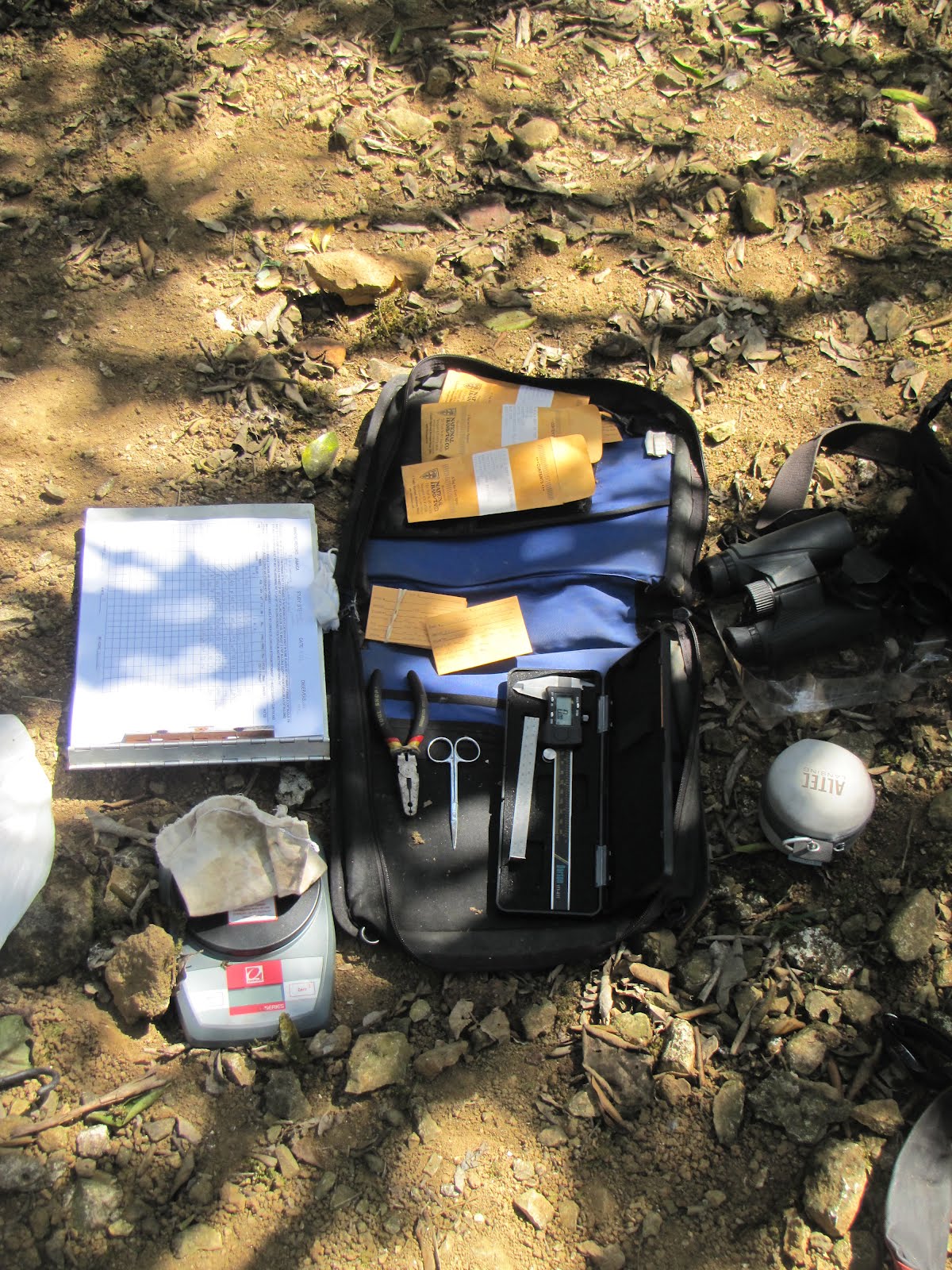
Thankfully he did not take her words to heart and was back at our side in 15 minutes. He kneeled by us at our banding station, saying nothing. Laura and I sat silently, sitting Indian-style amongst our banding pliers, calipers, cameras and binoculars, pulling biting ants off our bodies. As usual Andrew reeked of body odor and his cheeks were streaked with dust, old sweat, and orange pulp. Though usually barefoot, today he had a pair of dilapidated shoes with his giant toes sticking out through holes in the sides. He climbed up to the top of a nearby tree and pulled down a few oranges to eat. After an hour or so we heard someone screaming his name, which wasn’t an unusual thing to hear. People often exploited Andrew’s strength and got him to carry their bags of oranges for them. As the man kept calling for him, “AnDRUH! AnDRUH” he finally got up and disappeared, having not said a single word to us his entire visit.

As early afternoon approached the workday was coming to an end. We pulled down our nets, packed up our gear, and grabbed a few oranges for ourselves. We pulled out of the citrus, and as we wheeled around the curves, passing houses, schools and food stands, our ears caught the familiar sounds of the street - kids laughing, music blaring, and of course, every minute or so the call of “Whiteeyyy!! White woooman!!!! White man!!!!” We shook our heads, laughed, and continued on towards home.

The materials needed to make some homemade OJ, courtesy of the citrus.

A Change of Scenery

While at our house and working in the Copse plot we are mostly by ourselves, isolated and secluded. The only people we see regularly are the cattlemen and the people who work around the house. Though the solitude is pleasant, it is always nice to have a variety, and thankfully we have been granted that in the form of a new study site. The Citrus.

The valley below us is filled with vast citrus groves, where row after row of orange trees line the rolling hills. In addition to producing copious amounts of fruit for people to eat… many, many migrant warbler species live in this man-made habitat (although few resident species do). Since migrant warblers are what we are after, the citrus is a great study site, providing a contrast to the relatively pristine forest of Copse. What is the warbler density like down here? How healthy are they comparatively? These are the questions that we are trying to answer.

During the first few hours of each day the valley is blanketed by a dense fog. The citrus trees show the effects of this daily gift of moisture; the branches are draped with mosses and epiphytes, and if you look closely, orchids. Parulas and redstarts can be seen gleaning from the leaves and flying out in quick bursts to snatch flying insects while ovenbirds and waterthrushes hunt unobtrusively on the ground.

For the first week in the citrus, I spent my mornings wandering down the misty lines of trees, stopping at set points to survey the birds I could identify. After these preliminary assessments, we have begun capturing birds there, setting up nets within the citrus trees to color-band redstarts and assess the health of other warbler species we catch. Much like our work in the wet limestone forest, we set up 8-12 nets and leave them open from first light until early afternoon. We check the nets every 20-30 minutes, extracting the birds and taking them back to our makeshift banding station. We were able to borrow some extra nets from the other Smithsonian crew down in Whitehouse, and thanks to this, Ashley, Shawn, Laura and I have been able to split up into two separate banding teams, doubling our efforts.

Here are some photographs of some of the birds we have caught so far, with some explanations to boot. Woot woot!

Above is a migrant, a male Cape May Warbler, one of a couple that we've caught this past week.

Here is another migrant, a male Black-throated Blue Warbler. This species breeds in Canada, New England, and down the spine of the Appalachians. Abundant throughout Jamaica, they are the focus of much research on migrant biology down here.

This is an abundant, conspicuous resident of the citrus, the White-winged Dove. The people of Jamaica love to eat white-wings, and have devised a number of genius methods to catching them. Every time someone saw us holding one, they emplored us to give it to them to eat.

Here is the villain of the citrus, the Greater Antillean Grackle. Hordes of these guys maraud through the citrus, eating rotten fruit, bird eggs, and if they're lucky, a bird dangling in one of our nets. Thankfully we've had no grackle murders yet this year.

The Jamaican Mango. This endemic hummingbird is just one of many jewels zipping amongst the trees.

What's fruit without parakeets?! The Olive-throated Parakeet, seen here, is a common species throughout Jamaica, and one that we were very excited to have fall into our nets, provided that we kept our fingers clear of that nut-cracking beak.

And perhaps most shockingly of all, Laura pulled this bird out of the net one afternoon! A Merlin! This medium sized falcon migrates from the taiga of Canada down to the coasts of the North, Central, and South America during the winter. Needless to say, it was an absolute thrill to handle this bird killing machine.

Monday, February 27, 2012

Canine Introductions

Hey guys. Time to take a break from the birds for a little bit and show you something else. Our house has a wonderful assemblage of dogs, and thankfully these dogs are full of drama. Before I get into the drama, however, I must introduce the characters to you. They are known as follows: Momma Dog, Red Dog, and Silver Dog.

The bottom level of our refrigerator is dedicated to chilled pig guts, which come up from the pig farm once a week or so. These guts are fed to the dogs twice a week, along with the bones and meat scraps that we throw them after dinner. I fed them pig guts yesterday and made the poor decision of grabbing the guts with my hands - after five hand washes I can still smell the charming odor. The dogs love it however, and can gulp down an amazing amount at one time.

All three are adept at howling late into the night, chasing cars, and being overall no count skanks. We have leanred that ticks are big fans of dogs as well, and their eyelids and ear tips are often riddled with them. Here is a detailed photo account of our pooches:

Momma Dog(seen below) is the elder resident, who has given birth to many litters, and has the saggy nipples to show for it. As I said before, she is the mother of Red and Silver Dog. Momma Dog is incredibly spunky, and is sure to wag her whole body for you if you make eye contact with her. As you can see, Momma Dog was quite pregnant at the time of this photo.. but she got even chubbier than this.
Red Dog(seen below) is a female offspring of Momma Dog. She is the largest of the three and full of energy, liking to steal shoes and stash them under the tree in the front yard. When we are gone for a few days, she takes up residence on the back porch, sleeping in our cushioned chairs. She has never given birth, but last year she produced milk for Momma Dog’s babies. She might be sterile.
Silver Dog(seen below) is a female from last spring’s litter and she is very peculiar. She is evasive and cringes, acting as if she has been hit in the past and rarely let’s me touch her. She is submissive to the other two dogs.
So in addition to being no count skanks, these lady dogs excel at getting pregnant. Momma Dog has been obviously pregnant for the past month or so, but only over the past couple weeks have we noticed that Silver Dog is pregnant as well, although not nearly the girth of Momma Dog. Yesterday while sitting on the back porch, I heard a loud rustling from down the hill in the woods. After a few minutes, Momma appeared panting, covered in sticky seed pods. What was she doing down there? I had no idea.

Since then, however, more developments have transpired. We returned from a morning at the Black Morass to find Momma and Silver both missing and Red Dog sitting in the front yard all by her lonesome. Strange. Then Miss Rattay then told us that Silver Dog was under the house preparing to give birth! Ashley and Laura proceeded to crawl under the house and find Silver and Momma Dog had both scraped out dens in the rocky floor, but neither had given birth yet. Oh Excitement! The following morning, Red Dog was the only dog to be seen once again. Silver and Momma were both still under the house. After another inspection, it was discovered that both had given birth to six puppies, side by side. How cute! Who's the father? We're not sure, but it mostly likely is Brother-Dad, a dark male that appears here from time to time. From the little I've seen, he likes to hump, and yes... he is both brother and father. Below is the entrance to the crawlspace where the puppies were birthed.
Here is Silver Dog's litter, deep in the recesses of the house. To get to this spot you must crawl through two very small tunnels. Needless to say, this is the optimal hiding place for pups.
Below is Momma Dog's litter. Since the time of this photo, one of the pups has disappeared. Uh oh!
So anyways, this has been all quite enthralling for us. Now the countdown begins for the emergence of the puppies into the outside world.

Saturday, February 18, 2012

Ticked Off

So, I teased you guys last week about the mysterious duct tape strapped to my lower legs(see picture in previous blog post). Why did I have it on? What was it’s purpose? Surely it wasn’t purely fashion. Well, the time has come to tell you, and it can be summed up in one word. But I’m not going to make it that easy. The story is as follows.

Our main field site is located high up in the limestone hills behind Montego Bay on the property of a British family who, except for the occasional visit, no longer lives there. They allow us to stay there for a modest fee, and in turn we get a wonderfully convenient field station. The vast property, operated by many local employees, consists of a coffee plantation, an enormous pig farm, and grazing land for hundreds of cattle.. as well as one substantial section of mature wet limestone forest. The main house we’re staying in is called the Copse house, and is on the uppermost tier of the property(more on the house and its inhabitants to come in later posts).To start out with, we will to be working in this one section of mature forest, while later on we will do some work in the coffee, as well as at some other sites around the island.


View from our back porch, looking northeast towards Cockpit Country. The coffee farm is sitting unseen below us, and the pig farm is on the distant hills. Taken by Laura.

So, onto the work itself… Our mission is to catch all of the redstarts and black-throated blue warblers that are spending the winter in this patch of forest. We catch them with mist nets, which are eight feet tall and forty feet long and almost invisible. Once caught, each individual is banded with a unique combination of color bands. This allows for each bird to be identified as an individual later on in the field. Other measurements concerning its weight, health, and size are also taken. We spend the rest of our time mapping out the territories of each individual – the details of which reveal that the oldest males are dominant and thus get the highest quality habitats. Females and young birds live more marginal habitats, whether on the forest edge or in less mature forest. What makes one section of the forest better than the other? Well, hard to say for sure, but it likely comes down to, as with most things in this world, to food. The taller and wetter a section of forest the more diverse and abundant the food source. The taller the forest, the more habitats there are, from canopy, to mid-level, to understory and the ground. A young, second-growth section of forest is unlikely to have as many insect niches, and thus less insects as a whole. To study this dynamic further, we are taking insect samples at all of the sites we will be working.


Above is a photo of a male redstart that we caught. You can see the color bands on him which will help us in resighting him.

But, before we could get started on all that, we had to clear the road from the house to the forest plot. No one else drove that stretch, so it was up to us to tame a years worth of new growth. To make the task more daunting, the entire area was inundated with seed ticks, an exotic visitor from Africa. Drawn to the cattle, hordes of these needle-tip sized beasts sit on top of blades of grass in giant balls of hundreds to thousands of individuals, waiting for you to brush up against them. Once you do, they explode and disperse to infiltrate your being. Ashley, having worked here for three years, knew this and warned us, but there was only so much that words could tell us. She recommended that we each carry a roll of duct tape, and each time a “ball” of ticks got on us, to stop and use duct tape to pull them off as quick as possible. We worked for most of the day using machetes to clear the road before returning to the house in the late afternoon.

Despite my diligence, my clothes had become completely infested with ticks and my body was covered in hundreds upon hundreds of irresistibly itchy red welts. Despite a generous helping of Benadryl, I spent the night in a fitful state of self-mutilation. The next day I had to shave my legs so that I could properly treat them. A week later, the welts were still there, with bloody scabs and new welts rising all around them. There wasn’t a single stretch of skin on my body I could run my hand across without feeling lump after lump after lump. I looked like a poorly shaved poodle with lupus.


The top photo is a piece of duct tape with some seed ticks on it, as well as one giant "silverback" tick. A normal tick ball has about ten times as many as there are on that piece of duct tape. Yes. It sucks. The second photo is of A LOT of ticks, all pulled off at once. Below is my thigh a couple days after the first attack. My whole body looked like this.


Since then, I have learned my enemy and gotten better in my defense, and in turn by body as healed. A typical field day at Copse consists of a dawn departure from the house. My first order of business after breakfast and ablutions is to prepare my defense against the ticks. This entails tucking my quick-dry pants into my socks, wrapping that junction with duct-tape, putting my boots on, and then putting gaiters on after that. Then I tuck my shirt into my underwear, strap on my belt, and I’m ready to go. I always have a roll of duct-tape in my hip pocket, in case I get nailed with a tick ball. If that happens, I rip off a piece of tape and use it to pull off the ticks before they weasel their way into a crevice. We drive up above the house on the track we cleared(bypassing many ticks) to the Copse forest plot, passing through three gates before we enter the forest. The forest itself doesn't have many ticks, thankfully... even though the cows do escape into it every once and awhile.

Once we had caught and color banded some birds, we were able to start mapping out their territories(and still are), and to do this it takes great patience and attention to detail. In addition to the new birds we've caught, there are already several birds banded in previous years that have returned to the plot. To map a bird, I must stalk quietly down the paths that we have cut, listening for the chip notes of the birds to locate them. Once located, I watch it and plot on a grid where I have seen it, at what height in the forest, and what bands it is wearing. After months of doing this, we will have an excellent data set of the habitat partitioning amongst these birds, and what sort of territories each subset of redstart is getting. Perhaps most remarkable of all is the fact that we already know some of the redstarts on territory here have been returning to the exact same tree for the three or four years, all after a migration of over a 1,000 miles.

Of course, one added benefit of setting up a bunch of nets in Jamaica is that you catch a lot of other things as well! On average we have 10-12 nets set up, and have them open for around seven hours a day. Here are some pictures and captions of some of the things we’ve caught. Remember you can click on a photo to make it larger.


Jamaican Woodpecker. Common in all forest types in Jamaica. Taken by Laura.


Rufous-throated Solitaire. Endemic to Hispaniola and Jamaica. The solitaires are members of the thrush family, and have a haunting ethereal song. Taken by Laura.


Jamaican Tody. Todies are only found in the West Indies. Their closest relatives are the motmots and kingfishers. They are quite the sedate little birds, sitting still for long periods of time before flying out after an insect, audibly snapping its wings. Taken by Laura.


Arrow-headed Warbler. A resident warbler species endemic to Jamaica, most often found in wet mid-level forest, gleaning insects from the underside of leaves. Taken by me with Laura's camera.


A male Jamaican Spindalis. One of a group of closely related species endemic to the West Indies, this tanager is common in wet forests of Jamaica, eating fruit. Taken by me with Laura's camera.


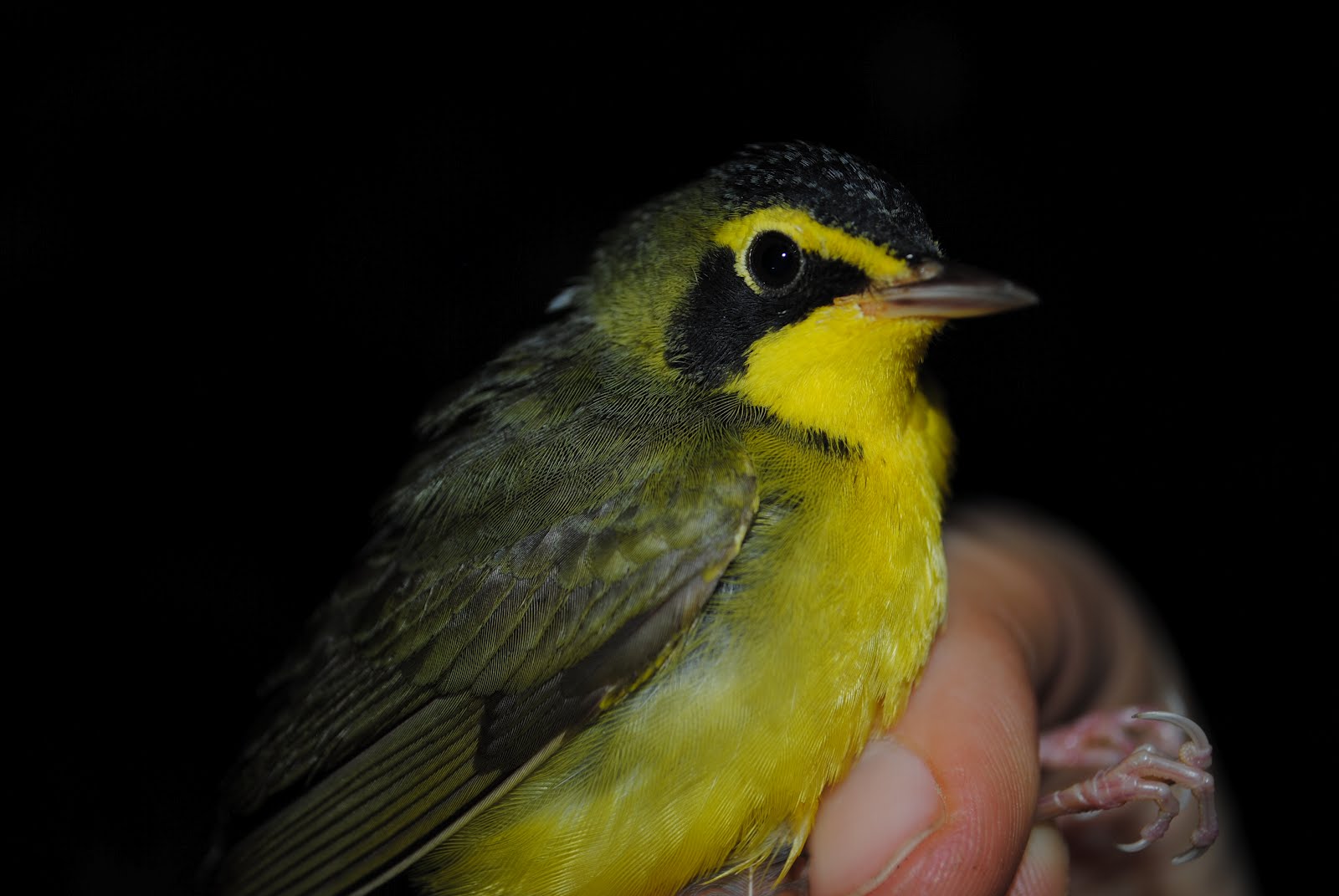
A male Kentucky Warbler. This is another migrant warbler species, and one that is listed as a vagrant for Jamaica. However, they are annual at the Copse field site. They breed in bottomland forests of southeastern North America. Taken by me with Laura's camera.

Sunday, February 5, 2012

Jamaica

Hey guys! It's Alan, and as you can see I'm back on Goodbye, Me after a long hiatus. Since my last post, I've spent time in Louisiana, Oregon, and Massachusetts, as well as back home in North Carolina. But now, I am in Jamaica and ready to start blogging again. Why am I in Jamaica? Well, my girlfriend Laura and I are first and foremost, studying birds, but adventure is a big part of it as well. We are working for a graduate student at Tulane University, and in turn the the Smithsonian Migratory Bird Center. Our study is focusing on American Redstarts and Black-throated Blue Warblers, two species of warbler that breed in eastern North America and spend the rest of the year here in the West Indies. What's remarkable about those two species in particular is the fact that they hold winter territories, and the dynamics of these territories is what we are studying. A single redstart will return to the same tree to spend the winter, year after year, all after over a 1,000 mile journey! WOWZA! But more on that in later posts... I'll keep it streamlined for now. Basically, Laura and I will be down here until May, capturing and studying birds and exploring the world of Jamaica. SOoooo... without further ado... let's start the journey. Here is post #1...

January 14th, 2012


As the plane descended into Montego Bay the stewardess came onto the intercom. She declared that everyone should get ready, because it was 84 degrees on the ground! Roars of exultation came from the rabid tourists who had been ordering cocktails and mini-bottles since the flight had taken off. Not everyone on the flight was so responsive to the weather announcement however. A young, fat rastafari in a wife beater and stocking cap sat quietly and a black man next to me offered me two Halls cough drops after I had sneezed into my hand. He promptly fell asleep against the window after that, which was okay with me, as I preferred to sit in silence as we approached.

Well, it was true. Montego Bay was indeed 84 degrees, and as the plane skimmed just above the coastline, aquamarine water met white sand just as it should. Beyond the coastline strand, verdant hills rose up into lush forest, where small colorful buildings were barely visible, tucked beneath the fronds, fruits, and flowers.

The humidity hit me like a wall as we filed out of the plane and into the airport. Moving through a bare white hallway, I followed the signs towards immigration. I had taken a separate flight than Laura and Ashley, who had arrived on a plane about 30 minutes before I had. Arriving at immigration, I was greeted by a line of 300 people, making switchbacks toward the front . Ashley had informed me that I might get some questioning from the immigration officers regarding the length of my stay, which, at four months, was a rarity among visitors. At long last I arrived at the booth, and answered a series questions – How long is your visit? What will your address be? What is the purpose of your visit? I answered all as I should. I will be here until May 10th. My address will be Kew Park, Betheltown. I am a volunteer on a scientific research project. I am a volunteer. All my expenses are paid. Repeat. I am not getting paid. She promptly asked – Who is your boss? I said she is over there in baggage claim. Her name is Ashley. Then I remembered that I had a sheet of paper with our Jamaican phone number and address printed out – maybe that would be more convincing. I handed the sheet to the young Jamaican woman, and as she glossed over it, she began to laugh and show it to the worker next to her. I had forgotten that on that same piece of paper was a blow-by-blow list of tips to get by immigration, rife with all the “right things to say,” and “what you might expect.” Of course that was hilarious to them. After their laughter subsided, she stamped my passport for 90 days and said I would need to come back two weeks before it expires to get it renewed or face a steep penalty. I was through!

In the airport parking lot we met up with a representative from the car rental company who handed over the keys of a new pick-up for us to drive off in. Our first stop in town was the Mega Mart, a giant store reminiscent of Costco. I, however, did not get to go inside, and had to stay with the pick-up to guard our bags in the back. Not knowing exactly what I was guarding against, I stood stoically behind the truck, switching around occasionally to sit on the back hatch. To pass the time, I nonchalantly watched the bird life around me. Glossy ibis lifted up from the wet grasses across the street, and a pair of mockingbirds danced across the lawn, throwing shadows over insects before they pounced. My attention was drawn to the cars that passed by me in the parking lot – hosting a wide variety of people, all of them either gawking, glaring, or avoiding me. Horrific dramas of assault and murder began to play out in my mind. What a shameful way it would be to go out!

Well, of course nothing happened, and as we continued onward, I learned from Ashley that we would be driving about an hour or so into the hills to where we would be staying, in an old estate of a British family that rarely visits anymore. The road that wound up into the mountains and away from tourist-land was sinuous, narrow, and full of potholes, and when combined with the left-side-of-the-road driving, quite harrowing. We passed through the towns of Anchovy and Rat Trap, where trash blew down the sidewalks and matchstick houses with zinc roofs blurred by.


Ashley’s informative words flowed fluidly into and out of my consciousness – The Jamaican government is bankrupt, they are trying to develop every undeveloped area left in the county - Nowhere is safe - They don’t give a shit about the land – it went on. I lost track of the words, and stared back out the window at the shoulder of the road, where a man and his two sons stood urinating, their backs turned to us. Wow. Ashley then told a story of a kid who once approached her and asked if she wanted to see a boa. Since the Jamaican Boa is an endangered species and rarely encountered, she eagerly asked the kid to lead her to it. There it was. In the chicken coop! Later she learned that they traded the boa so that the kids could get shoes. What can you say to that? We all agreed. Nothing.

Our journey towards Kew Park continued, and I focused again on the scenes passing by. The feeling of being in a 3rd world country started to come back to me, as I smelled the smell of exhaust fumes, burning trash combined with lush green vegetation, foreign signs and foreign faces. We pulled over to a plywood front with “corner jerk” scrawled on it. It was a small shop selling jerk chicken and jerk pork, and as Ashley ran in to grab us some, I watched a young boy wearing a red shirt and athletic shorts walking up the street, kicking a ball. As he launched the ball up the road, he made a gun with his hand and fired three shots into the sky before he ran around the corner and out of sight.


At last we pulled onto the dirt track that would take us to our house where we’d be staying the first few nights, while other researchers cleared out of the main house. It was an old, fortress turned cottage, with slots in the wall for firing weapons out of, and a tower that would fit right into medieval times. I took a moment to sit down. I could here music from Betheltown far below us. Mystikal, Notorious BIG, and Ghetto Superstar played in succession. My favorite music! Where was that music coming from, and what sort of people were down there? I sat back and closed my eyes and slowly but surely, my brain started to tackle my new home. Jamaica.

So... STAY TUNED. Many more posts to come.. hopefully once a week or so. And, maybe you are wondering why I am wearing duct tape on my ankles in that photo. Well, tune in later and you'll find out. IT'S A SCARY REASON. Wowza!

Monday, May 3, 2010

DON'T FORGET

Don't forget... hop over to BEER AND TREES!!!!!!!!! New posts are there right now.

www.beerandtrees.com